Is YouTube Killing the Dream of Easy Money? What the New Monetisation Rules Mean for Creators?
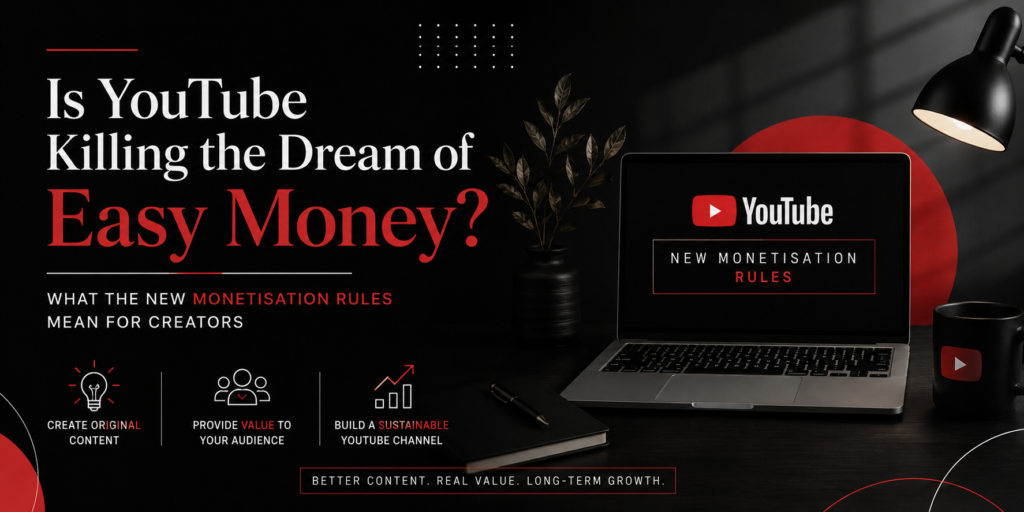
Table of Contents
Introduction
For years, YouTube has been seen as one of the easiest ways to make money online.
Create videos, upload them, get views, gain subscribers and start earning.
Sounds easy, right?
But is it really that simple anymore?
With millions of creators on YouTube and AI making content creation faster than ever, the platform is becoming more careful about the kind of content it allows to earn money.
YouTube has clarified its monetisation policy around “inauthentic content”, which includes content that is repetitive or mass-produced.
This has made many creators ask an important question:
Is YouTube killing the dream of easy money?
The answer is not exactly.
YouTube is not saying that creators cannot make money. Instead, it is making it clear that low-effort, repetitive and mass-produced content should not be an easy shortcut to monetisation.
So, let’s understand what the new YouTube monetisation rules actually mean for creators.
What Are the New YouTube Monetisation Rules?
First, there is one important thing to clear up.
YouTube did not suddenly introduce a completely new monetisation policy.
On July 15, 2025, YouTube renamed its existing “repetitious content” policy to “inauthentic content” and clarified that repetitive and mass-produced content is not eligible for monetisation. YouTube also said that this type of content had already been ineligible under its existing policies.
In simple words, YouTube wants creators to make content that is original, authentic and useful to viewers.
For example, imagine a channel uploading 100 videos using almost the same script, same format, same narration and same visuals, with only a few words changed each time.
That type of content can be considered repetitive or mass-produced.
The main message is simple:
Creating more content does not automatically mean earning more money. The content also needs to provide value.
Why Is YouTube Becoming Stricter About Monetisation?
Content creation has changed a lot in the last few years.
Earlier, making one video could take hours.
Now, AI tools can help create scripts, images, voiceovers and videos within minutes.
This is great for creators because it saves time.
But there is also another side.
It has become very easy to create hundreds of similar videos without putting much original effort into them.
For viewers, this can become boring very quickly.
Imagine searching for a topic on YouTube and finding 20 videos that all have almost the same script, voice and visuals.
Would you want to watch all of them?
Probably not.
This is why YouTube is putting more focus on original and authentic content instead of content created mainly to generate views. YouTube says monetised content should not be mass-produced, generic or repetitive and should be made for viewers rather than only for getting views.
Is AI-Generated Content Banned on YouTube?
This is probably the biggest question creators have after hearing about the new YouTube monetisation rules.
No, AI-generated content is not automatically banned.
YouTube’s guidance focuses on whether the content follows its monetisation policies and provides original value. The policy applies regardless of how the content was made.
So, using AI as a tool is not necessarily a problem.
For example:
Using AI to get content ideas, research a topic or improve your script = useful.
Using AI to create hundreds of almost identical videos with little or no original input = risky.
The difference is the effort and value added by the creator.
AI can help you create content faster, but it should not become a shortcut for creating endless low-value content.
What Type of Content Can Affect YouTube Monetisation?
The updated YouTube monetisation policy focuses on content that is repetitive or mass-produced.
Some examples can include:
- Videos made using the same template again and again.
- Content where only the title or a few words are changed.
- Videos with almost identical scripts or narration.
- Repetitive slideshow-style content with little additional value.
- Mass-produced videos created mainly to generate views.
- Generic content that provides little educational, entertainment or creative value.
The easiest way to understand this is:
If your videos feel like copies of each other, you may have a problem.
However, making multiple videos around the same topic is not automatically against the rules.
For example, a digital marketing creator can make 10 videos about SEO.
One can be about keyword research.
Another can be about SEO mistakes.
Another can explain a real SEO campaign.
The topic is similar, but the content and value are different.
That is very different from uploading the same video 10 times with minor changes.
What About Reaction Videos, Clips and Compilations?
This is another area where creators often get confused.
The new “inauthentic content” clarification does not mean that reaction videos, clips and compilations are automatically demonetised.
YouTube specifically says there has been no change to its reused-content policy, which covers content such as commentary, clips, compilations and reaction videos.
The important thing is whether the creator adds meaningful original value.
For example, a reaction video where a creator gives genuine opinions, commentary or analysis is different from simply uploading someone else’s video.
Similarly, adding educational information, storytelling, editing or analysis can make the content more original and useful.
So, the question is not simply:
“Did you use someone else’s content?”
It is also:
“What did you add to it?”
Is YouTube Really Killing the Dream of Easy Money?
Maybe it is killing the easy part.
But it is definitely not killing the opportunity.
For a long time, people looked at YouTube as a simple formula:
Upload videos → Get views → Get subscribers → Make money.
But today, the competition is much higher.
There are millions of creators.
AI has made content creation faster.
Short-form videos have changed how people consume content.
And viewers have endless options.
Because of this, simply uploading more videos is not enough.
You need to give people a reason to watch your video instead of the hundreds of other options available.
And this is where originality becomes important.
Quality Matters More Than Quantity
Consistency is important for a YouTube creator.
But there is a difference between being consistent and being repetitive.
Uploading three useful videos every week can be much better than uploading ten almost identical videos every day.
For example, suppose you are a fashion creator.
Instead of making 20 similar AI-generated outfit videos, you could:
- Share your own styling tips.
- Show real outfits.
- Compare different fashion trends.
- Share affordable shopping ideas.
- Give your personal opinion.
- Explain what actually works and what doesn’t.
The topic may remain fashion, but every video gives the viewer something different.
This is what creators should focus on.
Not:
“How many videos can I upload today?”
But:
“How much value can I give my audience?”
What Do the New YouTube Monetisation Rules Mean for Creators?
For genuine creators, these changes do not necessarily need to be scary.
In fact, they can be a good reminder to focus on the basics of content creation.
Creators should focus on:
- Original ideas
- Personal opinions
- Useful information
- Better storytelling
- Audience needs
- Unique perspectives
- Meaningful editing
- Authentic content
Think about a digital marketing creator.
Instead of creating a generic video saying “What is SEO?”, they can explain a real brand’s SEO strategy.
Instead of simply reading information from the internet, they can share their own observations.
Instead of using AI to create everything, they can use AI to save time and then add their own creativity.
This makes the content feel more human.
And most importantly, it gives viewers a reason to come back.
How Can Creators Stay Safe Under the New YouTube Monetisation Rules?
Creators do not necessarily need to stop using AI or completely change their content strategy.
They simply need to be more careful about the value they are providing.
1. Add Your Own Perspective
Don’t depend completely on automatically generated content.
Add your own thoughts, opinions, experiences, examples or analysis.
Your perspective is what makes your content different.
2. Avoid Making Every Video Look the Same
Having a consistent style is good.
But if every video has the same script, same structure, same visuals and almost the same information, it can become repetitive.
Try to give every video its own purpose.
3. Use AI as a Tool, Not a Replacement
AI can help with ideas, research, scripts, editing and other parts of content creation.
But don’t let AI completely replace your creativity.
Use it to save time, not to remove the human part of your content.
4. Focus on Your Audience
Before uploading a video, ask yourself:
“Why would someone want to watch this?”
If you don’t have a clear answer, maybe the content needs some more work.
5. Choose Value Over Volume
More videos do not always mean more success.
One useful video can sometimes do more for your channel than ten repetitive videos.
Focus on creating something people actually want to watch.
What Are the YouTube Monetisation Requirements in 2026?
The YouTube Partner Programme, or YPP, is the main programme that gives eligible creators access to YouTube’s monetisation features.
For full ad-revenue sharing, YouTube currently lists these main thresholds:
- 1,000 subscribers + 4,000 valid public watch hours in the last 12 months, or
- 1,000 subscribers + 10 million valid public Shorts views in the last 90 days.
YouTube also has an expanded YPP entry level in eligible regions, where creators can access features such as fan funding and Shopping earlier. The lower threshold is 500 subscribers, along with 3 public uploads in the last 90 days and either 3,000 public watch hours or 3 million Shorts views within the relevant periods.
However, reaching the numbers alone does not guarantee monetisation.
The channel still needs to follow YouTube’s monetisation policies and goes through a review process.
So, getting subscribers and views is only one part of the process.
Is YouTube Still Worth It for Creators?
Yes.
YouTube is still a powerful platform for building an audience, personal branding and income.
But creators need to understand that YouTube is not simply about uploading videos and waiting for money.
You need:
Good content + consistency + originality + audience understanding.
The new YouTube monetisation rules may actually help genuine creators because they put more focus on content that is original and valuable.
So instead of looking at these changes only as a restriction, creators can also see them as a push towards creating better content.
Frequently Asked Questions About YouTube Monetisation Rules
1. What are the new YouTube monetisation rules?
YouTube clarified its existing policy around repetitive content by renaming “repetitious content” to “inauthentic content.” The policy covers content that is repetitive or mass-produced and is not eligible for monetisation.
2. Is AI content banned from YouTube monetisation?
No. AI use itself does not automatically make a video ineligible. The important thing is whether the content follows YouTube’s policies and provides original value.
3. Can AI-generated videos be monetised on YouTube?
They can potentially be monetised if they meet YouTube’s monetisation requirements. However, creators should avoid mass-producing repetitive or low-value content.
4. Will YouTube demonetise repetitive content?
Repetitive or mass-produced content can be ineligible for monetisation under YouTube’s inauthentic content policy.
5. Can reaction videos still be monetised?
Yes. YouTube says there has been no change to its reused-content policy covering commentary, clips, compilations and reaction videos. The content still needs to meet the relevant monetisation requirements.
6. Does uploading more videos help with YouTube monetisation?
Uploading regularly can help a channel stay active, but quantity alone does not guarantee monetisation or success. Content should also be original, useful and engaging.
7. How many subscribers do you need to monetise YouTube?
For full ad-revenue sharing, YouTube currently lists 1,000 subscribers plus either 4,000 valid public watch hours in the last 12 months or 10 million valid public Shorts views in the last 90 days.
Conclusion
The new YouTube monetisation rules are not really about stopping creators from earning money.
They are about making it harder for low-effort, repetitive and mass-produced content to become an easy route to monetisation.
For creators, the message is simple:
Don’t just create more. Create better.
Use AI when it helps.
Be consistent.
Experiment with different formats.
But most importantly, add your own ideas, personality and value.
Because YouTube may be changing the rules around easy money, but it is not changing one thing:
Good content will always have a place on the platform.
Want to Turn Your Digital Skills Into a Career?
YouTube is just one part of the digital marketing world.
If you want to go beyond creating content and learn how SEO, social media marketing, paid advertising, content marketing, analytics and AI tools work together, building practical digital marketing skills can open up more career opportunities.
At Vidya Sarthi, you can learn AI-powered digital marketing through live classes, practical projects, industry-focused training, internships and placement support. You can even attend a 2-day free trial class before enrolling.
Ready to Build Your Digital Marketing Skills?
Learn. Practise. Build. Grow.
Explore Digital Marketing Courses at Vidya Sarthi →
Start your digital marketing journey with Vidya Sarthi today!